

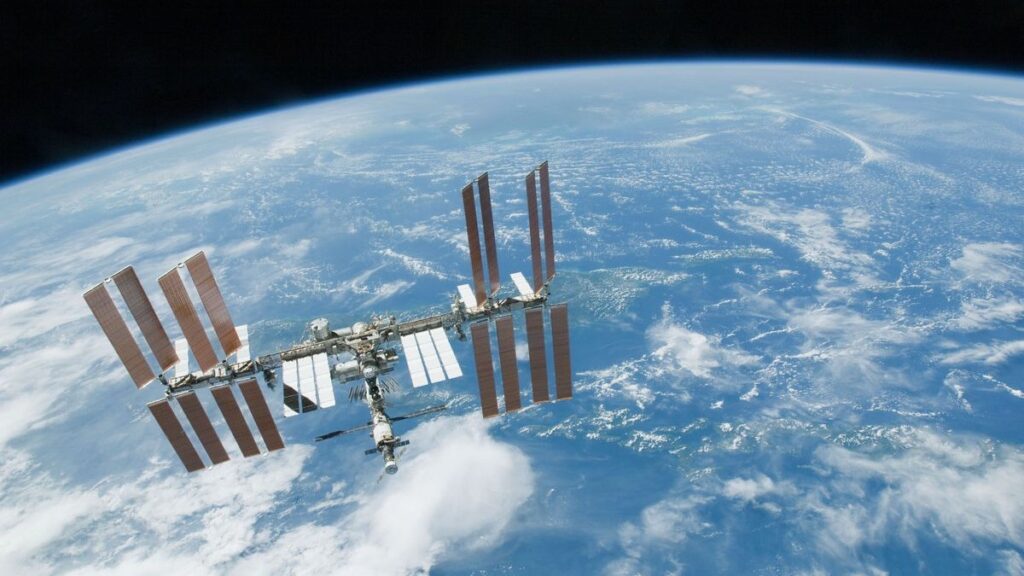
For more than two decades, the International Space Station has been humanity’s home in low-Earth orbit. Since the first crew arrived in November 2000, it has hosted continuous human habitation, serving as a laboratory, workshop, and symbol of international cooperation. But all things must evolve. Now, NASA and its international partners are charting out a final chapter for the ISS, aiming to deorbit it in 2030 and usher in a new era of privately owned orbital platforms.
Why Retire the ISS?
The decision to retire the ISS is driven by a combination of technical, logistical, and strategic factors:
- Aging infrastructure: Many components of the ISS were built in the late 1990s or early 2000s and were originally designed for a ~30-year lifespan. By 2030, much of the hardware will be well past its intended service life.
- Maintenance burden and risk: As the station grows older, maintaining systems becomes more complex and costly. Issues like micro‐leaks or structural fatigue are harder to mitigate.
- Limited alternatives: NASA considered several decommissioning schemes: disassembling the station, boosting it to a higher orbit, or letting it decay naturally. Ultimately, the controlled reentry option was judged to minimize risks to people and property.
- Shift in NASA’s role: Rather than continue to own and operate the orbital lab, NASA seeks to become a customer of privately operated stations — analogous to how it buys crew and cargo transport from commercial providers today.
- Strategic reorientation: With the Artemis program, lunar Gateway, and Mars ambitions, NASA must reallocate resources. Offloading LEO operations helps free funds and focus for deep space exploration.
The Plan: A Controlled Deorbit
Rather than risk an uncontrolled tumble back through the atmosphere, NASA plans a carefully controlled descent into a remote ocean region, aiming for minimal environmental impact.
Key elements of the plan:
- U.S. Deorbit Vehicle (USDV)
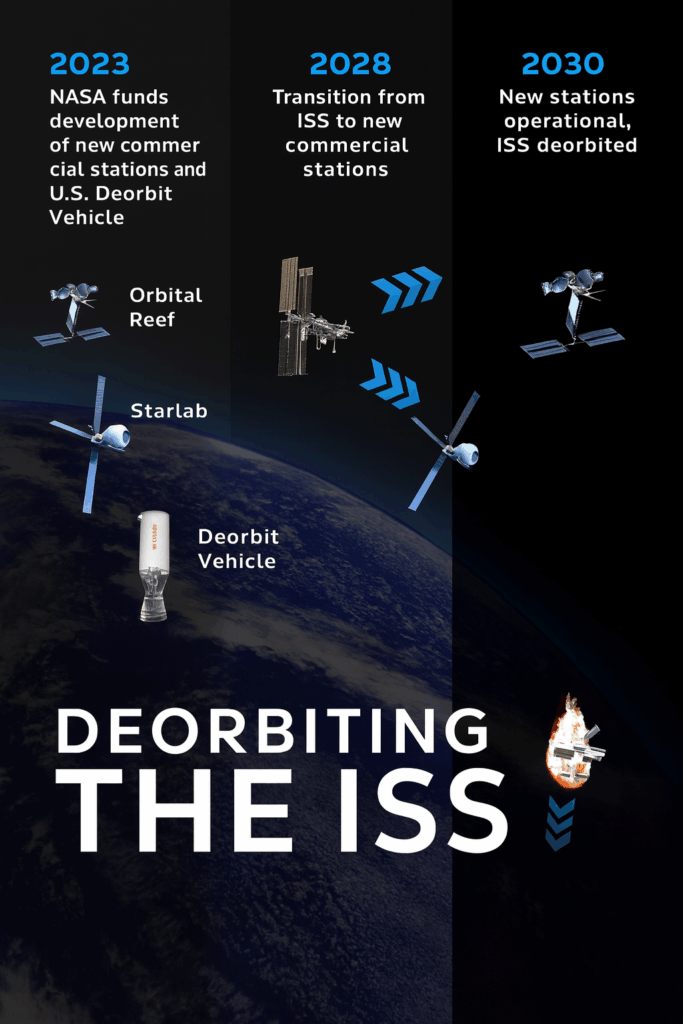
NASA has awarded SpaceX a contract (valued up to $843 million) to design and build a specialized deorbit tug.
After development, NASA will take ownership and control of the probe during its mission.
The vehicle is expected to be based on modified Dragon architecture but with greatly enhanced propellant capacity, power, and thrusters. - Timing and sequence
- NASA aims for the USDV to be ready by around 2028–2029 so it can be used in the final descent phase.
- The final crew may depart the ISS via late 2029 or early 2030, with the station’s orbit allowed to decay over the course of 12–18 months before the final burn.
- The final deorbit burn will push the station into the atmosphere over a remote stretch of the Pacific Ocean. The site likely will be “Point Nemo,” a location far from land, which has been used historically as a spacecraft debris zone.
- What happens on reentry?
As the station plunges, aerodynamic heating will cause it to break apart. Solar panels and radiators are expected to detach early, followed by module separation and truss disintegration. Most of the structure will burn up; any surviving fragments will fall into the ocean and sink.
NASA’s environmental assessments suggest no significant long-term impact from residual debris.
Risks and dependencies
- The plan hinges in part on Russia continuing participation through the agreed timeframe (at least to 2028). If Moscow withdraws earlier, deorbit planning would become more complex.
- Delays in commercial station readiness could lead to gaps in U.S. presence in LEO.
- The deorbit tug must perform flawlessly on its first mission: any anomaly could jeopardize the descent or risk debris drifting off course.
What Follows: Commercial Stations Take the Helm
NASA’s strategy is clear: don’t just replace the ISS — supersede it with a more flexible, commercially sustained ecosystem. To that end:
- NASA launched the Commercial LEO Destinations (CLD) program (also called Commercial Destinations in Low Earth Orbit). The goal: support private companies to build space stations in which NASA is a tenant rather than owner.
- In 2021, NASA awarded funding (over $400 million in aggregate) to multiple commercial station proposals.
- Among the leading concepts:
- Axiom Space / Axiom Station: Already in development, Axiom plans for modular segments to dock with the ISS beginning ~2027, then detach and form a free-flying station.
- In late 2024, Axiom revised its plan: its first module (the Payload Power Thermal Module, or PPTM) will dock to the ISS, and later detach to join a habitat module (Hab-1) to form the independent station.
- Starlab: A joint venture of Voyager/Nanoracks + Airbus, Starlab is aiming for launch around 2028. The concept is compact and optimized for science and commercial experiments.
- Orbital Reef: A Blue Origin / Sierra Space initiative, pitched as a “mixed-use business park” in orbit, targeting initial operations in the late 2020s.
- Some concepts have drifted or merged; NASA continues to evaluate which designs will meet safety and performance criteria.
- Axiom Space / Axiom Station: Already in development, Axiom plans for modular segments to dock with the ISS beginning ~2027, then detach and form a free-flying station.
- NASA has published a transition plan for ISS operations and commercial adoption, including safety certification, docking agreements, logistics, and staffing.
The hope is that by the time the ISS is retired, one or more commercial platforms are ready to assume the mantle — enabling continued scientific research, technology development, manufacturing, and even space tourism in LEO.
Timeline at a Glance
| Phase | Target Date | Milestone |
|---|---|---|
| Commercial station R&D and prototyping | 2025–2028 | NASA issues RFPs, selects partners, performs design reviews |
| USDV development | 2026–2029 | SpaceX builds and delivers the deorbit tug under contract |
| Commercial station launch & commissioning | ~2027–2029 | Axiom and/or Starlab (and others) launch modules and achieve operational readiness |
| Final crew departure & ISS orbit decay | Late 2029 – early 2030 | Last crew returns, station orbit begins gradual decay |
| Final deorbit and re-entry | 2030 (possibly early 2031) | USDV performs deorbit burn, station enters atmosphere and descends into remote ocean |
There is some uncertainty: a few sources suggest a possible final burn in early 2031 depending on schedule shifts. Some delay tolerance is built into the planning, but the goal remains 2030.
Legacy, Risks, & Implications
As the ISS begins its twilight years, it continues to host ongoing research and technology development. NASA has emphasized that “we’re not done yet” — many experiments and scientific results are still to come.
That said, the transition is not without risk:
- If commercial stations are delayed, the U.S. might face a gap in continuous human presence in orbit.
- The deorbit vehicle must perform flawlessly on its maiden mission — failure is not an option.
- International cooperation remains essential; Russia’s continued participation through 2028 (or beyond) is uncertain.
Yet, should it succeed, this transition marks a watershed moment in space access:
- NASA breaks from the role of station operator and becomes a customer, potentially lowering costs and stimulating innovation in the LEO economy.
- Private actors take on greater responsibility for infrastructure, logistics, and sustainability in orbit.
- The focus of exploration can increasingly tilt toward the Moon, Mars, and beyond — unhindered by the burden of operating a massive Earth-orbiting laboratory.
A Final Look Up
In the coming years, as rockets ferry final modules and crews to the ISS and commercial stations rise alongside it, the night sky will start to tell a new story. The familiar arc of the ISS may eventually fade, but it will be succeeded by modular, private habitats, livelier and more diverse than anything that came before.
Between now and that moment, each pass overhead reminds us that the ISS is not just metal and solar panels — it’s a monument to cooperation, discovery, and humanity’s ambition to reach beyond our home planet. Let’s make sure we appreciate it while we still can.