

Introduction
“When humanity finally opened hotels in orbit, the cost per night was staggering—but that was just the beginning of a new economy.”
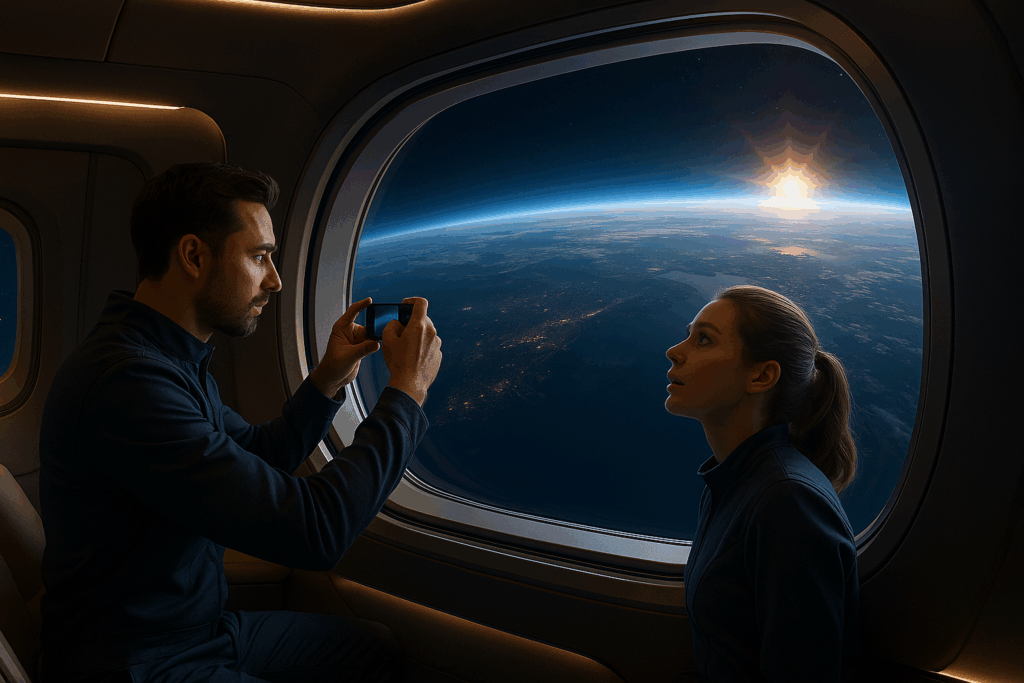
At some point in the 2030s, as the first commercial orbital hotel welcomes its guests, headlines will focus on the breathtaking views, the microgravity spa, and the first champagne toast over Earth. But behind that glamour lies something far more consequential: the birth of a new economic frontier. The journey from terrestrial tourism to space-borne tourism is not just a novelty—it’s the seed of transformative shifts in industries, capital flows, regulation, and human ambition.
In this post, we’ll unpack how orbiting hospitality could rewrite economics as we know it. What will space tourism cost (today vs. future)? How will it generate value, jobs, and spillover industries? What risks and structural constraints might hold it back? And in the most adventurous corners of projection, how might orbit-based markets reshape terrestrial economies?
1. The Current Market Landscape: From Billionaires to Budgets
Early pioneers and the “ultra-luxury” era
The commercial space tourism era didn’t begin with full hotels in space; it began with single seats on Soyuz capsules. Dennis Tito became the first self-funded space tourist in 2001, paying tens of millions to hitch a ride to the International Space Station.
For almost two decades, space tourism was the domain of ultra-wealthy individuals, novelty seekers, or patrons of science. These were high-ticket, low-volume flights—the kind of headline stunts that captured imaginations but lacked scalable economics.
Market sizing and growth forecasts
Today, the market is still nascent—but it’s growing fast. In 2023, the global space tourism market was estimated at US$888.3 million. Projections suggest that by 2030, it might expand to US$10.09 billion, growing at a compound annual growth rate (CAGR) of about 44.8%.
Other forecasts are more conservative. A recent industry report suggests the market was about US$1.3 billion in 2024 and could reach US$6.7 billion by 2030, and some observers place space tourism as a subset of a broader space economy that could reach US$1.8 trillion by 2035.
These numbers reflect both optimism and uncertainty—but the trajectory is clear: the space tourism sector is one of the fastest-growth segments in the broader space economy.
Suborbital vs. orbital economics
In today’s models, most early space tourism will be suborbital (brief flights over the Kármán line) rather than sustained orbital stays. Suborbital trips are less complex, require less infrastructure, and thus lower cost thresholds (though “low cost” is relative when dealing with rockets and life support systems).
Some projections expect suborbital ticket prices to fall from current levels (~US$400,000–450,000) to something in the $200,000–300,000 range by 2030. As volume, reusability, and operational maturity improve, prices could compress further. The challenge is whether the economics of orbital and multi-day stays can ever converge toward sustainable margins for average high-net-worth travelers.
2. Cost Structure: Where the Money Really Goes
To understand how orbit changes economics, it’s crucial to break down costs. What are the major expense categories for a space tourism business, and which can be driven down?
Launch & propulsion
This is the single largest cost driver. Rockets, fuel, propulsion systems, staging, and booster recovery all demand capital, precision, and redundancy. Historically, rocket launches have been expensive precisely because they must be engineered for extreme reliability.
The advent of reusable rockets (Falcon 9, Starship, etc.) has already chipped away at that barrier, making multiple flights per booster possible. This reduces marginal cost per flight. But there remain high fixed costs—manufacturing, refurbishment, inspections, safety margins, and lifecycle maintenance.
Vehicle & habitat development
Designing spacecraft, capsules, orbital modules, docking systems, life support, radiation shielding, thermal control—these all require intensive R&D. The initial up-front capital expenses are enormous.
For an orbital hotel (or even “hotel-module”) you need not just transport but habitat systems: pressurized modules, docking, power and thermal regulation, autonomy, redundancy, and maintenance.
Life support, consumables & replenishment
Each guest needs oxygen, water, food, climate control, waste recycling, pressure control, safety systems, and—over longer stays—resupply missions of consumables. The more closed-loop and efficient your recycling systems, the less you have to ferry from Earth, but perfection is costly.
Some costs scale with mass and crew time. If a guest’s life support cost per day is nontrivial (because of redundancy, system stress, spare parts), those costs accumulate quickly for multi-night stays.
Ground infrastructure & logistics
The orbit economy doesn’t begin at altitude—it begins on Earth. Launchpads, ground operations, fueling, transport to launch site, integration facilities, assembly, personnel, telemetry, control centers—all of that must scale.
As space tourism grows, demand for more launch sites, processing facilities, spaceports, and transportation networks (roads, rails, airports to spaceports) will increase. Governments and private developers will play a vital role in building that infrastructure.
Insurance, regulation, safety & compliance
High-risk operations require stout insurance, multiple redundancies, regulatory compliance (national and international), safety protocols, licensing, redundancy audits, contingency infrastructure, and crisis management. These non-revenue costs are material.
Especially early on, insurance premiums may dominate operating margins until safety becomes more proven. Also, liability, regulatory delays, and compliance impose friction and overhead.
Marketing, customer training, experience
Selling “space tourism” is not just about the rocket ride; it’s also the training, pre-flight simulators, medical screening, marketing, customer service, mission support, backup plans, and contingency customer care. These costs—though not rocket-science scale—become significant in scaling an experience business model.
3. Revenue Models & Value Capture
How does a space tourism business make money? What levers exist to increase margins? Below are multiple revenue and value paths.
Ticket sales and package pricing
This is the most obvious: customers pay for the ride, the stay, the view. Pricing will be tiered by duration, altitude, luxury add-ons, and unique experiences (spacewalks, external windows, experiments, viewing angles).
Recent developments like Stoke Space’s $510 million raise are accelerating the economics of reusable rockets, a key factor in driving down launch costs for future orbital travelers.
As the experience becomes more modular, packages might unbundle components: “hotel stay only,” “flight-only,” “privileged window deck,” etc. What might some of these packages look like? Let’s take a look:
1. Launch & Return Experience — The “Edge of Space” Sampler
Duration: ~2 hours | Price: ~$250 000 per person (2030 est.)
Target market: Adventure travelers, influencers, corporate clients
This is the entry-level experience — a suborbital parabolic flight just past the Kármán Line. Guests experience:
- A full pre-flight training day at a luxury “Spaceport Lounge,” complete with centrifuge demo and virtual-reality orientation.
- Personalized flight suits tailored and embroidered with name and mission patch.
- Six minutes of weightlessness, panoramic Earth curvature views, and onboard 360° cameras capturing each traveler’s expressions in real time.
- An optional “post-reentry gala dinner” streamed with zero-G footage and certificates of completion signed by the mission commander.
Think of it as the Virgin Galactic First Class, with collectible merchandise and social cachet baked in.
2. Orbital Overnighter — The “One-Night Above Earth” Getaway
Duration: ~36 hours | Price: $1.2 – 1.8 million per guest
Target market: Ultra-high-net-worth individuals, couples, luxury brands
Once in low Earth orbit, guests dock at an orbital capsule hotel — perhaps with six to eight suites. Packages might include:
- Private window modules positioned to view sunrise over the Pacific.
- Gourmet meals designed by celebrity chefs in partnership with Michelin-rated restaurants, re-engineered for microgravity plating.
- A “floating photography” session with professional orbital photographers capturing portraits against the curve of Earth.
- Optional add-ons: spacewalk tether ride (for an extra $500 000), or livestreamed interviews for personal media.
- Return capsule gift: a “Gravity Reclaimed” sculpture—tiny crystal spheres forged from re-entry-heated metals of the flight hull.
Economically, this tier generates enormous brand halo value. Each mission becomes part documentary, part status symbol.
3. The Orbital Week — Luxury Suite Package
Duration: ~7 days | Price: $5 – 8 million per guest
Target market: Executives, space-faring honeymooners, early adopters of orbital living
This is the true “space vacation.” Guests arrive via dedicated shuttle and settle into pressurized, boutique-style modules. Amenities might feature:
- Climate-controlled sleeping cocoons with adjustable visual displays simulating circadian rhythm and gentle artificial gravity fields.
- A microgravity spa using magneto-fluidic water spheres and ultrasonic massage chairs that float the guest mid-air.
- “Chef-in-Residence” tastings: seven-course menus paired with views of auroral curtains or city lights far below.
- Morning yoga in 0.3 g rotational rings.
- Live concert streams or artist residencies performed from orbit for guests and virtual audiences on Earth.
- “Orbital wellness checkups” with biometrics logged into a personal health archive—half science, half souvenir.
Expect this package to rival the economics of super-yacht charters: limited clientele, immense margins, and near-infinite bragging rights.
4. Corporate & Expedition Packages — The “Mission Partner” Tier
Duration: Varies (3 – 14 days) | Price: Negotiated contracts, $10 – 20 million range
Target market: Corporations, universities, media networks, and national agencies
Orbit hotels will quickly discover that their facilities can double as microgravity laboratories, film sets, or team-building retreats. Imagine:
- A research wing where biotech firms run crystallization or fluid-dynamics experiments between tourist visits.
- Exclusive product-launch packages (literally) where a company unveils its brand from orbit via live global stream.
- Film studios hosting limited-crew shoots for the first “space-filmed” series.
- Executive leadership retreats using space as metaphor—complete with guided workshops on perspective, teamwork, and adaptation.
Such contracts anchor revenue in predictable B2B deals and smooth seasonal tourist demand.
5. Lunar Layover — “Orbit-to-Moon” Grand Tour
Duration: 10 – 14 days | Price: $25 – 40 million per guest
Target market: Extreme luxury explorers, national patrons, philanthropic adventurers
By the late 2030s, orbital hotels may serve as staging nodes for lunar tourism. A “Grand Tour” ticket could include:
- Two nights acclimating in Earth orbit;
- Transfer aboard a lunar transport;
- Three-day orbit around the Moon with close-pass views of Tycho Crater;
- Optional descent to a surface dome for a champagne toast with Earthrise in view.
The package blends frontier prestige with seamless logistics — a modern echo of the 19th-century Grand Tour, just 400 000 kilometers higher.
6. The Lifetime Orbit Pass — Subscription Futures
Structure: Membership / equity hybrid | Price: $1 million annual retainer + usage fees
For repeat visitors and investors, companies might introduce orbital memberships—like private-jet or yacht clubs but cosmic. Benefits could include:
- Guaranteed booking windows for limited suites.
- Invitations to exclusive zero-G galas and scientific briefings.
- Access to future facilities (lunar, Mars transit).
- Dividend credits tied to hotel profitability or orbital real-estate appreciation.
In effect, the first space loyalty program—points redeemable for altitude.
Add-Ons & Dynamic Pricing Elements
Expect dynamic, algorithmic pricing similar to airlines and cruise lines: adjusting based on orbital trajectory, solar-activity forecasts (aurora visibility!), launch cadence, and suite orientation. Add-on possibilities are boundless:
| Add-On | Description | Est. Price |
|---|---|---|
| Aurora Pass | Night in window module aligned for polar orbit viewing | +$150 000 |
| Zero-G Dining Experience | Private chef & floating dinner filmed in 8K VR | +$250 000 |
| Mini-Sat Deployment | Launch a personal nanosatellite w/ name engraving | +$300 000 |
| Extravehicular Snapshot | Assisted spacewalk photo session | +$500 000 |
| Commemorative Artifact | Jewelry or sculpture forged from re-entry alloy | +$25 000 |
| Carbon Offset Program | Funding of orbital debris cleanup or green launch tech | +$10 000 |
7. Psychological Currency: What the Ticket Really Buys
Ultimately, these packages aren’t selling time—they’re selling transcendence. Customers aren’t paying $2 million for two days; they’re paying for the sentence, “I orbited the Earth.”
Each pricing tier monetizes human emotion: awe, fear, belonging, legacy. Early operators will master the art of transforming logistics into luxury narrative. The ticket becomes a passport to an era of expansion — and perhaps, the first asset class of a multiplanetary hospitality industry.
Experiments, payload & R&D access
An orbital hotel or station can host microgravity research, small-scale experiments, equipment deployments, and paid payloads. Some guests may want to bring small scientific or commercial payloads (e.g. biotech, materials, zero-G manufacturing).
Thus, some of the revenue could come not only from tourism but from “commercial researcher stays” or experimental hosting fees.
Licensing, partnerships & branding
Luxury brands, beverage companies, media/film shoots, product launches, content creation, influencer marketing—all of these can be monetized. Imagine a cosmetics brand filming a zero-G campaign inside an orbital habitat, or a fashion house launching a “space capsule collection” with media tie-ins. Licensing and sponsorship deals can offset costs or even subsidize portions of construction.
Secondary and derived services
In the same way land resorts have spas, restaurants, shops, tours, and experiences, orbital hotels might monetize photo sessions, external-viewing platforms, spacewalk excursions, guided science tours, or “orbital glamping” modules.
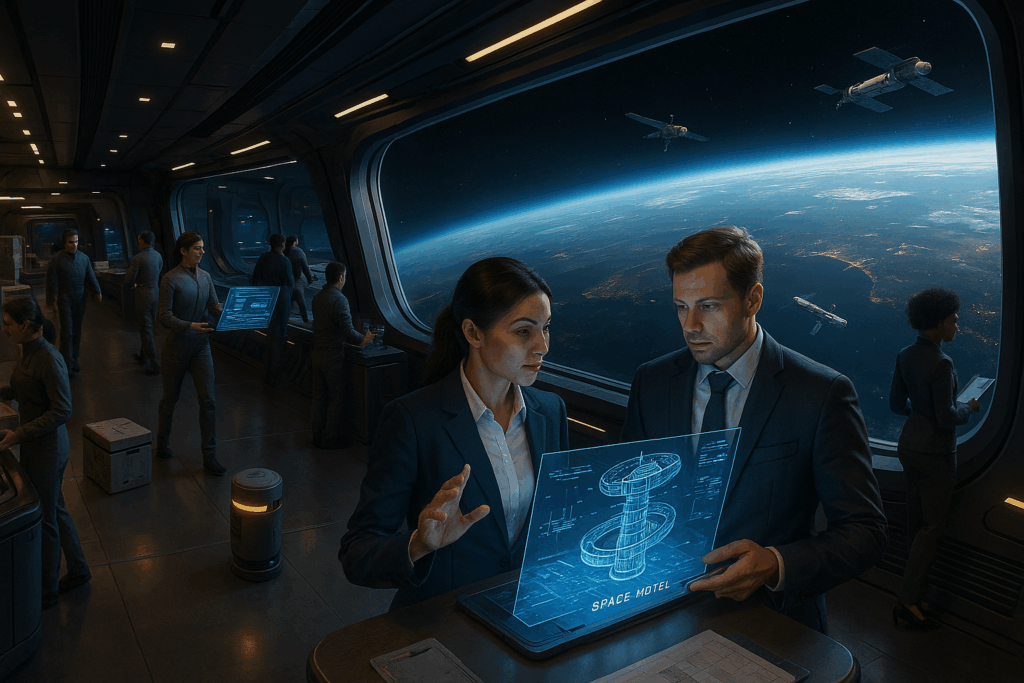
Furthermore, orbital ports may host supply docking, cargo transfer, and re-supply margins. Over time, a “servicing economy” may support refueling, repair, robotics, spare parts, and allied services.
Financing, debt & equity returns
At scale, space tourism ventures can raise capital, issue bonds, or obtain low-interest loans backed by future cash flows. Investors may accept lower margins for long-term growth—much as real-estate investment trusts (REITs) finance hotels on Earth. The challenge will be structuring risk and return for early investors in a high-risk frontier.
Ancillary brand & media monetization
The stories, the imagery, the exclusivity—those create marketing and media value. Documentaries, livestreaming, virtual reality “space tours,” merchandise, NFTs, and experiential content can drive ancillary revenue streams.
One imaginative direction: “virtual tickets”—people on Earth buying a live VR stream of an orbital sunset or sunrise hosted from the hotel.
4. Spillover & Spillforward: Industries That Rise in Orbit’s Wake
The orbiting hotel is just the tip of the iceberg. The real economic gravity lies in the ripple effects across entire ecosystems. Below are sectors likely to grow.
Launch & propulsion services
As tourism demands more frequent, reliable launches, demand for launch services will surge. New entrants, competition, and optimization will push down cost-per-kg to orbit. This scale effect will benefit satellite launches, interplanetary missions, logistics, and national programs.
Space logistics and supply chain
Transporting goods, robot servicing, spare parts, fuel, propulsion modules, and infrastructure components becomes a robust logistics sector. Think of “space trucking,” orbital tugs, cargo freighters, refueling hubs, and in-space manufacturing.
This in turn can reduce dependency on Earth-supplied parts, accelerate expansion, and lower marginal costs for all orbital services (not just hotels).
Materials, manufacturing & mining
As we push further, asteroid mining, lunar resource extraction, and in-situ resource utilization (ISRU) become critical. Space tourism can help justify initial infrastructure and anchor demand. The minerals, metals, or water mined in space could be used for fuel, construction, or propellant.
Manufacturing in microgravity or vacuum (for specialty materials) might become economically viable, enabling new products that can only be made off-Earth.
Robotics, AI & autonomous systems
Robotic platforms to repair, inspect, refurbish, or build will become essential. AI systems for habitat control, predictive maintenance, fault detection, and autonomous docking will grow in demand. These innovations may spin back to terrestrial robotics sectors.
Tourism infrastructure on Earth
More launch sites, spaceports, training centers, transport links, hotels for pre- and post-flight stays, medical screening centers, simulators, marketing agencies—all these “back-end” terrestrial businesses will see growth. A cluster effect around launch zones may resemble how airports spur development of hotels, restaurants, and transit hubs.
Education, media, branding & cultural shifts
Space tourism will shift how society imagines “travel.” Demand for space education, training programs, certification courses, documentaries, VR experiences, and space-themed entertainment will expand. Media content around space hotels, real-time streaming, and immersive experiences will grow in value.
5. Macro & Regional Impacts
Beyond the direct industries, the growth of space tourism and the orbit economy can influence macroeconomics, regional development, geopolitics, and inequality.
GDP, productivity & growth
Large space programs historically have had multiplier effects. A Cambridge working paper argues that space-sector activity has had substantial positive spillovers into innovation, productivity, and long-run growth in advanced economies.
As space infrastructure becomes part of national capabilities, revenues from orbital tourism and ancillary services could contribute meaningfully to GDP in countries with a space presence.
Regional “space hubs” & economic clustering
Countries and regions that invest early in launch infrastructure, favorable regulation, and support industries may attract clustering of space-related companies. Think of a future “Silicon Valley of Space.” Regions with coastal sites, stable regulation, and skilled labor may become beneficiaries.
For example, Florida’s Space Florida authority claims more than US$5.9 billion in cumulative economic impact since 2007 from aerospace activities.
Geopolitics, sovereignty, and space diplomacy
As countries see orbital infrastructure—spaceports, hotels, stations—as strategic assets, space tourism intersects with geopolitical interests. National security, communications dominance, and space diplomacy will influence regulatory regimes and market access.
China, for instance, has announced plans for state-backed space tourism flights by 2027–2028, with ticket prices in the range of 2 to 3 million yuan (~US$415,000) per trip. That signals a state-level interest in being a player in the orbit tourism market.
6. Cost Decline & Economies of Scale: The Path to “Affordable”
For space tourism to shift from elite novelty to broader market, costs must collapse by orders of magnitude. But is that plausible? Let’s trace the levers.
Learning curves & experience curves
Like aircraft, rockets and orbital systems may follow a learning curve: each doubling of cumulative production brings cost declines (e.g. 10–20%). As operators launch more frequently, inspect faster, streamline repairs, refine reuse, and optimize logistics, marginal costs shrink.
Increased flight cadence and utilization
If a given spacecraft or habitat module can service multiple customers per month, fixed costs spread over more flights. Higher occupancy, shorter turnover, modular payloads, and reuse all push margin upward.
Standardization, modular design & mass production
Standard modules, mass-produced components, modular habitats, plug-and-play systems, and automation can bring cost down. Rather than custom one-off spacecraft, companies will aim for “hotel room modules in space” akin to standard room modules in terrestrial hospitality.
Technology innovation & disruptive breakthroughs
Breakthroughs—beamed power, space tethers, new propellants, high-efficiency reusable architectures, advanced shielding materials—could cut cost trajectories or even leapfrog conventional designs.
Vertical integration and supply chain control
Companies that control both rocket, habitat, logistics, and supply chain (vertical integration) may reduce markup friction. If you own launch, you can schedule fully, optimize manifest, and internalize what used to be external supplier margins.
Subsidies, public-private partnerships & infrastructure funding
Governments may underwrite launch pads, offer tax incentives, grant subsidies, or invest in orbital infrastructure—lowering burden for private operators. Public-private cooperation will likely be pivotal in early decades.
7. Risks, Constraints & Wildcards
No bold economic projection is complete without acknowledging the caveats, constraints, and speculative wild cards.
Regulatory & legal uncertainty
International space law (Outer Space Treaty, liability regimes, jurisdiction, resource rights) is still evolving. Ambiguities in who owns what, who enforces rules, and cross-border liability for accidents pose risk.
Also, national regulation on launch safety, export controls, environmental impact, orbital traffic management, and spectrum licensing may slow progress.
Insurance & risk premiums
High-risk early operations will carry hefty insurance premiums. Accidents (even minor) can reshape public perception and investor appetite. A catastrophic event could reset the viability of the entire tourism sector.
Demand elasticity & pricing limits
There’s a limit to how much people are willing (or able) to pay for orbital vacations. If initial ticket prices remain too high relative to perceived value, demand could plateau. Demand models must consider risk tolerance, income distribution, competition from VR/AR, and substitute experiences.
Recent work in explainable AI models indicates price, income, risk of fatality, age, gender, and perception all strongly influence consumer decisions.
Saturation, competition & market fragmentation
Multiple players (SpaceX, Axiom, Blue Origin, Virgin Galactic, Sierra, etc.) may compete for limited demand. Differentiation may lead to fragmentation, margin erosion, and overcapacity in early phases.
Technical setbacks & system reliability
Space operations are unforgiving. Failures in propulsion, life support, radiation protection, or docking systems can be fatal. Margins must include redundancy. Unexpected technical setbacks could cause cost overruns and delays.
Environmental & sustainability concerns
Rocket launches leave emissions, ozone impacts, and atmospheric perturbation. As tourism scales, environmental regulation may impose constraints or taxes. Some studies warn about cumulative effects on ozone and climate.
Capital intensity & long payback periods
Investing in orbital infrastructure is capital-intensive with long horizon returns. Investors must wait years, perhaps decades, before seeing profits. This may limit capital pools to entities comfortable with long-term risk (governments, space-focused funds, ultra-long-horizon investors).
8. Speculative Scenarios: What Might the Orbit Economy Look Like by 2040–2050
To crystallize how economics could reshape, here are several plausible (and more speculative) future scenarios.
“Luxury frontier”: Space tourism remains niche, but high-margin
In this scenario, orbital hotels remain ultra-luxury, with perhaps a dozen modules in orbit, and ticket prices still in the multi-hundred-thousand to low millions. Demand is limited but stable among high-net-worth customers, celebrities, scientific patrons, and companies seeking PR. Profits exist, but the orbit economy remains a prestige niche rather than mass tourism. Ancillary businesses—space logistics, robotics, small payloads—make most of the value, not tourism itself.
“Democratized orbit”: Costs plummet, middle-tier access
Thanks to dramatic technology improvements, reusability, vertical integration, mass production, and some public subsidies, orbital stays fall to, say, $100,000–$200,000 per night (or lower). Middle-tier wealthy travelers (e.g. high-earning professionals) begin to afford stays. Occupancy and usage rates grow. A broader network of hotels, transport shuttles, and orbital transit hubs arises. The orbit economy begins to tangibly interact with Earth-based tourism, real estate, and media.
“Orbit as transport”: Orbital stopovers & transit hubs
By the mid-21st century, orbit hotels are not just destinations—they are waystations. Travelers heading to the Moon, Mars, or beyond stop for “rest and recharge” in orbit hotels. Cargo and passenger traffic use these orbital nodes. The orbit economy becomes a transport infrastructure: hotels, docking ports, refueling hubs, and transit lines. In such a world, the economics of orbital stops may rival or exceed tourism revenue itself.
“Orbital city-states”: Self-sustaining orbital economies
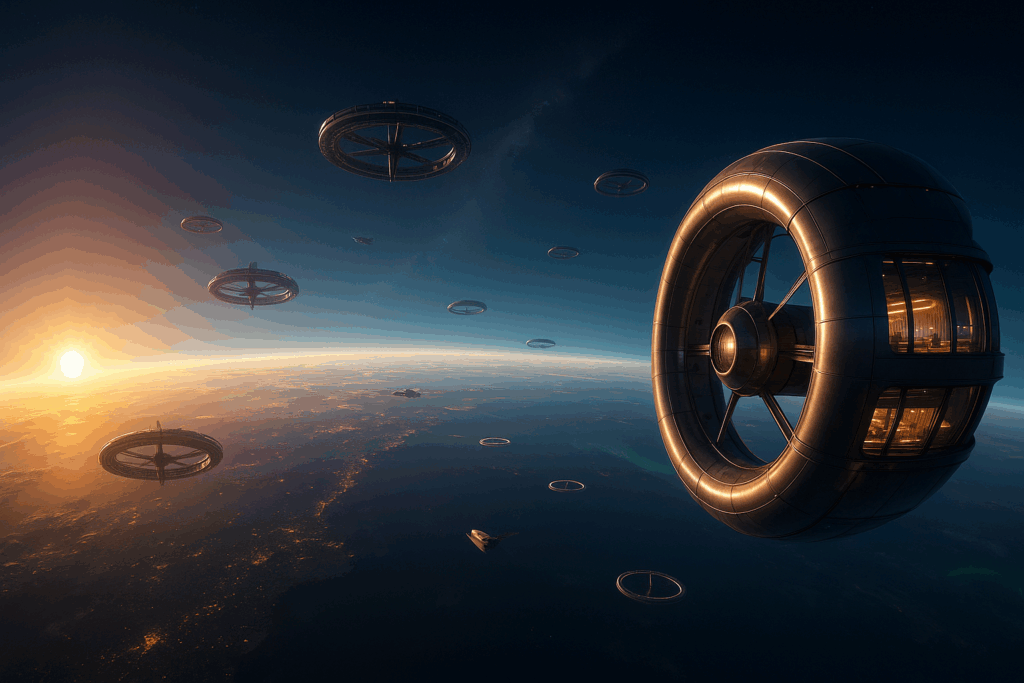
This is the ultra-speculative but fertile ground. A cluster of orbital habitats, manufacturing modules, tourism modules, research labs, and energy harvesting stations evolves into a self-sustaining off-Earth economy. Orbital “states” issue their own currency, trade with Earth (e.g. rare materials, energy, data), and host permanent populations. Tourism is just one node in a full-blown extra-terrestrial economy.
“Sprawl into moons and asteroids”: The orbit economy as springboard
Orbit hotels become launch pads for Moon base expeditions, asteroid flyby cruises, or deep-space tourism. As space infrastructure deepens, the orbital economy becomes the backbone to broader off-Earth economic expansion. The first lunar resorts, asteroid mining outposts, and interplanetary cruise liners may all trace roots to orbit-backed capital and logistics.
9. Summary & Outlook
Space tourism and orbit-based hospitality are still in their infancy—but the economic potential is already immense. Though initial flights cater to the ultra-wealthy, the long game is in building infrastructure, logistics, and revenue models that transcend mere novelty.
If costs can sustainably decline by orders of magnitude, if demand can broaden, and if regulatory and safety frameworks can mature, we may well see a branching of Earth’s economy into space. The orbital hotel will be a lodestar in this shift—less as a final destination and more as the cornerstone of a multi-planetary economic architecture.
In the coming decades, capital allocation, geopolitical competition, ecosystem growth, and consumer demand will determine whether orbit becomes a new frontier of accessible human presence—or remains a dazzling but exclusive dream.
One day, our children will look up at the night sky and see not just stars, but cities — bright, deliberate constellations of human ambition orbiting in silence. The first space hotels will be more than destinations; they’ll be declarations, proof that wonder still drives the human race to build what it can only imagine. From these glowing rings above Earth, economies will bloom, ideas will cross continents in minutes, and borders will blur into blue and gold beneath. The economics of orbit will not be written in numbers alone, but in the quiet awe of every traveler who watches a sunrise from space and realizes — we were always meant to go further.