

“We once looked upward and asked, ‘Who else is out there?’ Now we ask, ‘How will we live up there?’”
When the first space tourists boarded rockets, it was a spectacular novelty — a moment of transcendence, a journey into the unknown. But the next frontier is not just about going to space. It’s about living there. As commercial space stations, orbital hotels, and lunar habitats draw closer to reality, the biggest question becomes: What will daily life off Earth actually feel like?
In this post, we’ll move from the rockets to the routines. We’ll explore how sleeping, eating, exercising, socializing, and even psychological well-being must evolve in zero gravity. And we’ll imagine how living in orbit—or beyond—reshapes our definition of “home.”
I. Introduction – From Dream to Daily Life
Space travel has captured human imagination for over half a century — rockets, moon landings, Mars aspirations. But those spectacular missions are episodic adventures. True space tourism demands the shift from “spectacle” to sustained presence.
In other words: this is not just about orbit hops and snapshots from the cupola window. It’s about what life looks like when the unfamiliar becomes routine.
In this post, we’ll dive into the everyday: how you’ll sleep, dine, exercise, socialize, maintain health, and preserve mental balance among the stars. By the end, you’ll see that living in space isn’t fantasy — it’s a design challenge, a lifestyle revolution, and perhaps the next stage of human evolution.
II. The New Definition of Luxury
Luxury on Earth often equates to plush textures, expansive space, high-end finishes, and seamless service. In microgravity, luxury takes on a different geometry.
Designing for Constraints
Space habitats must juggle multiple constraints: mass, volume, structural strength, radiation shielding, life-support systems, and modular upgrades. Within those limits, designers must carve out luxury — a sense of comfort, privacy, and delight — without sacrificing safety.
In practice, that means:
- Multi-functional spaces: Components and surfaces will serve multiple roles (foldable walls, retractable structures, modular furniture).
- Sensory richness: Textures, lighting, biomorphic shapes, and soundscapes to counter the sterile, mechanical environment.
- Adaptive environments: Interiors that shift in lighting, orientation, or function depending on the use-case (work, rest, social).
- Window orientation and views: Maximizing picturesque vistas of Earth, sunrises, auroras — the “living room with a view” becomes literal.
Some corporate designs, like Airbus’s “Loop” habitat, propose three-tier structures: a habitation deck, a science deck, and a centrifuge deck to simulate gravity.
As we’ll see, “luxury” in space becomes a harmony between humanity and engineering, blending constraints into delightful surprises.
III. Sleeping Among the Stars
Sleep is deeply biological — tied to circadian rhythms, gravity, and environment. In microgravity, sleep becomes a delicate choreography.
Astronaut Sleep vs. Tourist Sleep
On the International Space Station, astronauts typically sleep in small crew quarters — sleeping bags tethered to walls to prevent floating off. Some familiar features:
- Individual “sleep stations” — small compartments with padding and acoustic dampening
- Lighting designed to simulate day-night cycles to regulate circadian rhythm
- White noise and ambient sound masking to muffle mechanical systems
Yet, space tourism will aim higher. Guests will expect more comfort, better aesthetics, and fewer constraints.
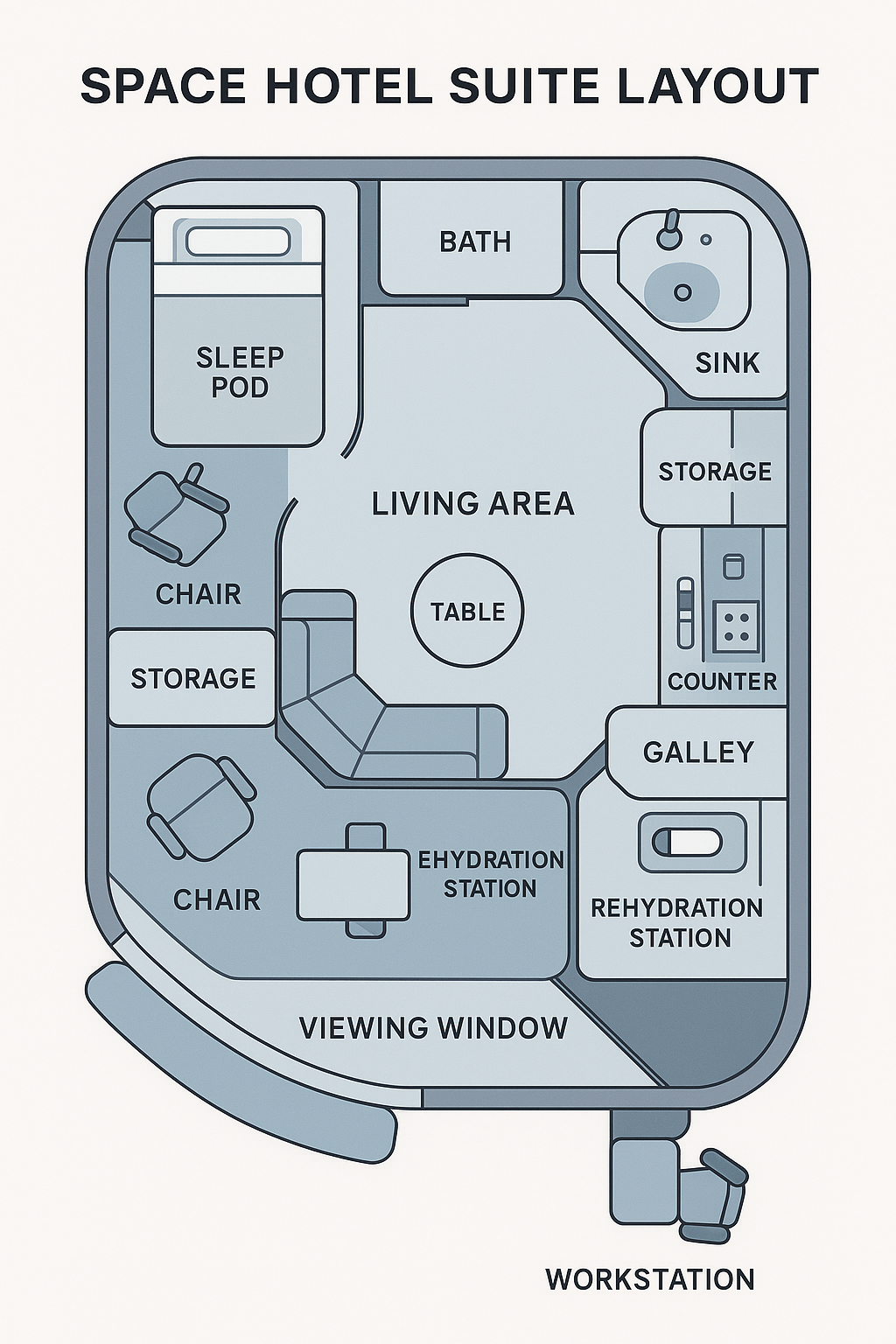
Concepts for Space Hotel Sleep Pods
- Anchor systems & magnetic points: Soft straps, anchoring points, or magnetic lining lets you “attach” to a wall or pod.
- Vibration damping: Gyroscopic stabilizers or dampers to cancel micro-vibrations that might otherwise disturb sleep.
- Adaptive lighting: Smart LED systems to mimic sunrise/sunset color temperature shifts, gradually dimming or brightening to cue wake/sleep transitions.
- Soundscaping & acoustics: Use of directional speakers or “sound bubbles” to isolate ambient mechanical hums, plus gentle white-noise masking.
One exciting possibility: AI-driven personalized sleep modulation. A system could monitor heart rate variability, micro-movements, CO₂ levels, and then adjust lighting, ambient temperature, or even airflow to optimize sleep. Over time, it could “learn” your optimal sleep signature in microgravity. This may even benefit as a pre-launch feature that you live with for a period of weeks at home prior to launch.
Circadian Anchors & Earth Analogues
To stay human, occupants will crave a re-created day-night rhythm. Even in constant orbital daylight/darkness, habitats may enforce a 24-hour lighting/darkness cycle, tied to an Earth-based time zone or locally generated schedule. Stimulants, blue-light filtering, and smart scheduling will help maintain coherence.
Sleep in space will not simply be “floating and closing your eyes” — it will be a managed, designed experience tailored to human biology in a novel environment. Luxury demands it.
IV. Dining in Orbit
Food is more than fuel — it’s comfort, ritual, social glue, and among the most visceral reminders of Earth. But in weightless environments, preparing and consuming food becomes its own design frontier.
Constraints of Microgravity Dining
- Liquids float, particles drift, utensils lose utility.
- Food must be packaged to prevent debris, crumbs, or leaks.
- Nutritional requirements shift (metabolic changes, bone/muscle maintenance).
- Taste perception changes — many astronauts report dulled senses of salt and spice in microgravity.
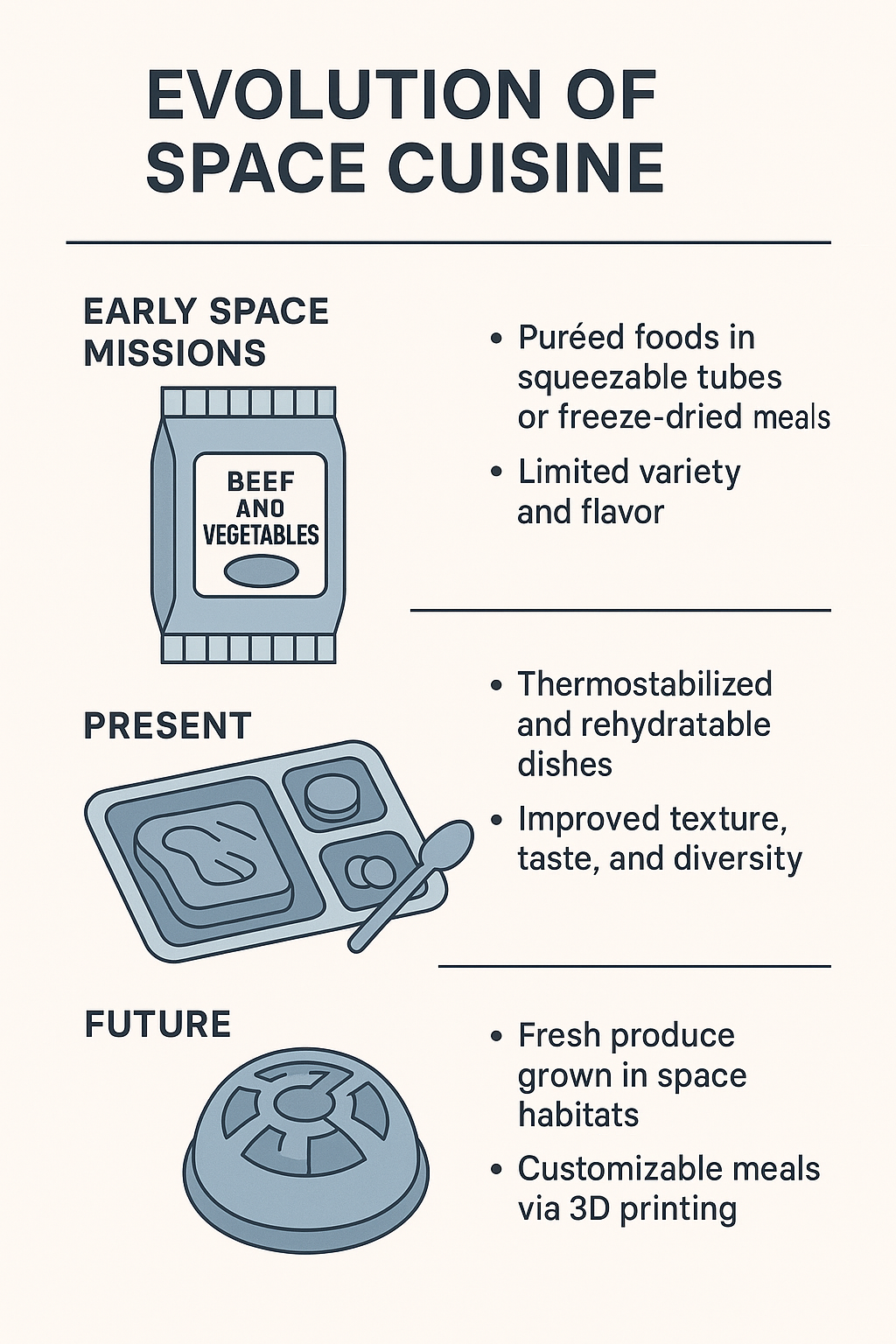
NASA’s space food systems team already provides modular menus, rehydrated meals, and personal “comfort food” items.
One review notes that “food mass and volume remain highly constrained, despite increased energy demands.”
These challenges and constraints are definitely things that need to be overcome, however, with the phenomenal creativity of chefs and engineers, there is no doubt that there are people up to this challenge.
From Freeze-Dried to Gourmet Rehydrated Cuisine
For space tourism, the goal is not “barely palatable sustenance” but culinary delight.
- Pre-cooked, vacuum-sealed entrees: Heat-and-eat modules that unfold and “snap open” in place.
- Rehydration stations: Systems to inject water into dehydrated foods in a contained environment.
- Texture-enhancing techniques: Encapsulation or gels that restore mouthfeel in low pressure.
- Flavored gel pods and modular condiments: Users could add flavor intensities (spicy, tangy, smoky) as required.
- Collaborations with celebrity chefs: Already underway in concept — some proposals suggest high-end chefs designing “space menus” to elevate quality and appeal.
One intriguing possibility: microbiome-tailored food systems. As research explores how gut microbes affect brain health in space, future food modules might be customized for individual microbiomes to boost cognition and resilience.
Taste, Sensation, and Sensory Deprivation
Because fluids and volatile compounds disperse differently in microgravity, taste perceptions shift. Chefs may lean heavier on umami, acid, spice, and aromatic compounds to compensate.
Mealtime remains deeply social — allowing guests to dine “face to face” (or float-face) around a central table, tethered seats, or communal food interfaces. In some designs, the viewing windows might frame Earth or sunrises, turning dinner into immersive theater.
Dining experiences are part of a broader evolution in orbital hospitality, from meal service to private lodging. Discover how these first rooms are beginning to take shape.
Meal Rituals & Social Bonding
- “Chef’s Table” modules: Occasional special dinners or tastings would only serve to make an already memorable occasion that much more special.
- Shared cooking or prep in safe modules (perhaps limited to certain dishes) to increase immersion.
- Celebratory events: Wine (or non-alcoholic analogs), ceremonial plating, themed nights.
- Cultural menus: Regional Earth cuisines rotated over weeks — a “tour of Earth” while off Earth.
Space dining will redefine gastronomy: food as performance, delight, memory.
Dining in Orbit: A Feast Among the Stars
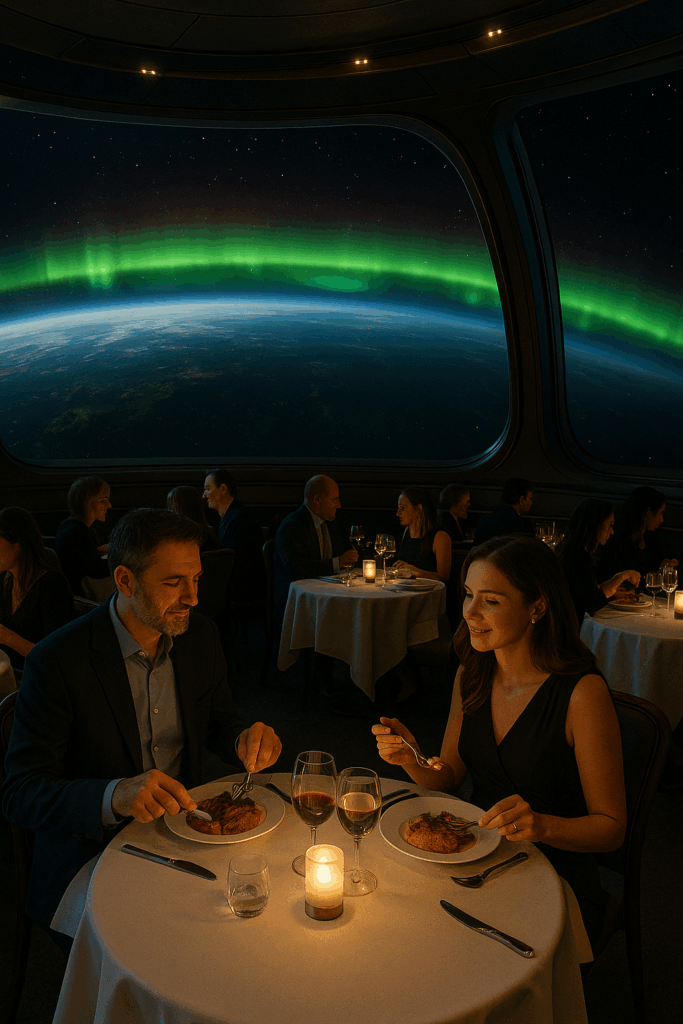
The experience of dining in orbit will redefine what it means to “go out to eat.” Imagine it not as a simple meal, but as a sensory event suspended between Earth and infinity.
The View Is the Menu
Guests float gently into a glass-domed dining chamber, tethered in place around a slow-rotating ring. Below them — a living canvas of Earth: oceans rippling with moonlight, cities glimmering like constellations of their own. The ring’s slow spin creates just enough centrifugal pull to let a wine glass settle on a magnetic coaster. As the meal begins, the entire restaurant turns—imperceptibly—offering a panoramic view of dawn chasing the curve of the planet.
Each course is timed to celestial phenomena. The appetizer arrives as the first line of sunlight breaks the horizon. The main course coincides with the crimson glow of orbital sunset. Dessert — a cloud of caramelized foam infused with vaporized espresso — is served in total darkness, illuminated only by the auroras dancing above the poles. The universe becomes part of the plating.
Culinary Theater in Zero-G
Chefs in orbit will not just cook — they’ll perform. Picture a floating culinary ballet: ingredients drifting in midair, captured in delicate motions by tethered utensils and magnetic serving platforms. Liquids form shimmering globes that chefs pierce with infused flavors, creating edible orbs that explode with taste upon contact.
A “zero-G sommelier” guides guests through molecular pairings — vapor infusions, aromatic mist clouds, temperature gradients that shift with altitude. Each dish becomes a physics experiment: sauces that bloom in concentric rings, pastas that coil themselves in midair, and desserts assembled by robotic arms that dance around the table like mechanical dragonflies.
This isn’t novelty. It’s the birth of orbital gastronomy.
Galactic Cuisine & Interplanetary Menus
Some future menus might feature “lunar salt,” mined from trace minerals in Moon regolith simulant, or “Mars spice” — a red dust seasoning cultivated from iron-rich biomes aboard Mars transit habitats. Hydroponic greens grown in the ship’s life-support gardens are harvested minutes before service, while fermented yeast proteins and algae-based caviar bring sustainability and luxury into balance.
Every dish tells a story — the journey of a planet, the ingenuity of adaptation, the narrative of survival turned into celebration.
The Floating Banquet
For special occasions, guests may attend the Floating Banquet — a once-per-stay event where the restaurant depressurizes slightly to allow food and people to drift freely. Each participant wears a tethered belt while spherical dishes and drinks orbit gently between them. Music drifts from every direction — perhaps an ethereal symphony composed specifically to match the slow ballet of floating guests and twirling plates.
It’s less a meal than a communion — a shared recognition that humanity has learned to dine where no kitchen has ever stood.
The Future: Taste as Teleportation
Eventually, orbital dining could transcend physical presence entirely. Imagine AI-assisted “taste replication,” where sensory data from Michelin-starred chefs on Earth is transmitted to orbit, re-creating the exact flavor, aroma, and texture using molecular printers and nutrient gels. Diners could experience real-time meals being served simultaneously across Earth and orbit — a new kind of shared experience, connected through taste rather than proximity.
In orbit, dining will no longer be a pause in the day. It will be the day’s highlight — the poetry of survival transformed into ritual. For travelers spending weeks among the stars, the dinner table may become the most human place in the cosmos.
V. Health, Fitness, and Medical Support
In Earth’s gravity, our bodies adapt over eons. In space, they adapt anew — with consequences.
Challenges of Microgravity on the Body
Without gravity:
- Bone density declines: Loss of bone mass can reach ~1% per month in weightless environments.
- Muscle atrophy: Especially in load-bearing muscles.
- Fluid redistribution: More blood toward the head, facial puffiness, vision changes.
- Cardiovascular deconditioning: Reduced exercise capacity, orthostatic intolerance.
- Gastrointestinal changes: Digestion slows; waste transport is altered.
- Immune system shifts & microbiome changes: The closed habitat environment can amplify immune stress and microbial exchange.
NASA’s human adaptation research underscores the need for integrated countermeasures: exercise, nutrition, pharmaceuticals, and environmental conditioning.
Exercise as Life Support
No gym on Earth? No fugitive treadmills in orbit either. Exercise modules should be compact, efficient, and aesthetically integrated.
- Resistance exercise rigs: Elastic or fluid-based resistance devices that simulate weight.
- Compact multi-axis rigs: Equipment that lets you perform squats, rowing, lunges, overhead presses in constrained volume.
- Vibration platforms: Low-frequency whole-body vibration exercises to stimulate bone.
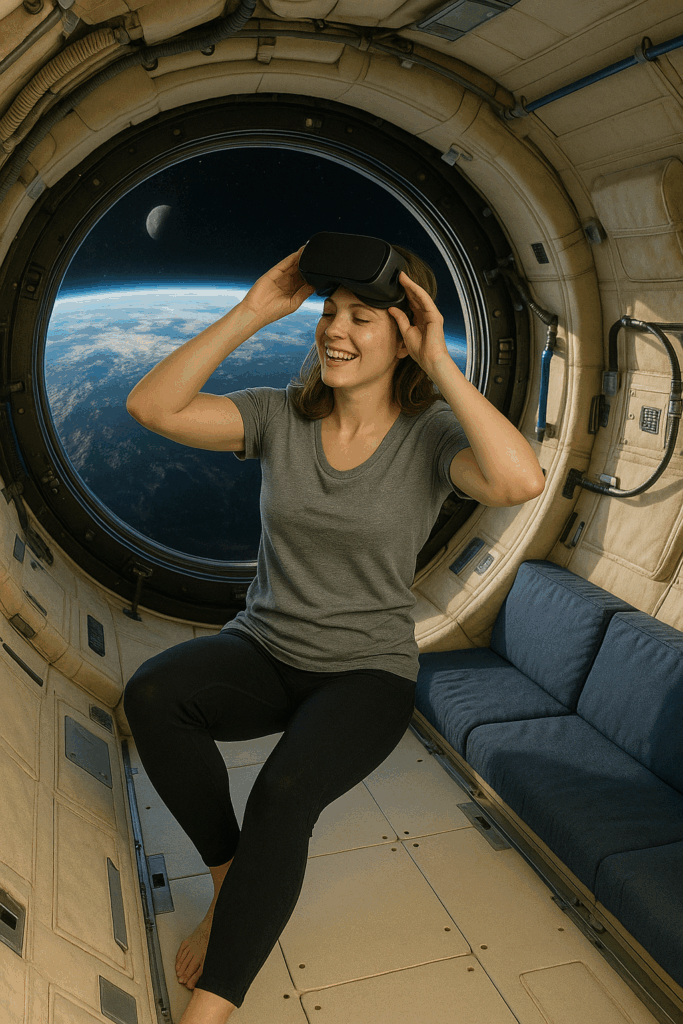
- VR-integrated workouts: Immersive exercise sessions — e.g. cycling over alien landscapes or boxing in lunar terrain simulators.
- Group fitness classes: Maybe a “floating yoga” session by window, or synchronized HIIT in tethered zones.
Designing fitness into the fabric of living — not a separate room — will keep use rates high.
Medical Support & Telehealth
Civilians in space expect medical safety. Key systems:
- Onboard medical bay: Compact modular units for diagnostics (blood analysis, imaging, ECG).
- Telemedicine & AI diagnostics: Real-time remote consultation plus AI-assisted triage.
- Emergency protocols: Rapid decompression shelters, first-aid modules, medical evacuation procedures.
- Radiation monitoring: Wearables to alert residents of solar flares or cosmic events.
Safety, redundancy, and modular upgrades will be non-negotiable.
VI. Social Life and Entertainment
If a space hotel is just sterile pods, it fails. The magic lies in shared experience, wonder, and connection.
Shared Spaces & Communal Design
- Central lounges & “sky domes”: Large windows framing the cosmos.
- Common seating pods: Soft modular seats that anchor to walls or surfaces.
- Floating conversation pods: Tethered round tables where guests can drift while talking.
- Event modules: Transformable zones for movies, lectures, concerts, VR shows.
- Observation decks: Quiet zones for Earth gazing, auroral viewing, sunrise/sunset cycles.
Holographic Concerts & Immersive Media
Entertainment in microgravity can unlock new forms:
- Holographic performers: Bring terrestrial artists into orbit.
- VR/AR immersive portals: Guests could walk through Earth landscapes, forests, oceans while floating.
- Interactive Earth link sessions: Live feeds, concerts, or panels with Earth-based audiences.
- Zero-gravity games & sports: Spatial chess, ball games in 3D (floating tennis?), navigation courses.
- Art installations: Suspended sculptures, kinetic art, drifting installations.
Imagine a room where guests gently float while watching dancers or a holographic orchestra. The boundary between spectator and space becomes fluid.
Internet, Connectivity & Social Media
Connectivity will be critical. High bandwidth, low latency links (e.g. satellite constellations) ensure guests remain connected — streaming, social sharing, VR calls, even remote collaboration.
Because we are social creatures, ensuring robust connectivity is also a psychological anchor to Earth.
VII. Sustainability and Waste in Space
You can’t simply flush away problems in orbit. Every resource is priceless.
Closed-Loop Life Support
Habitats must recycle — water, air, waste — in tight loops to minimize resupply needs.
- Water reclamation & purification: From hygiene, condensation, urine, and humidity capture.
- Carbon dioxide removal & oxygen regeneration: Chemical scrubbers, plant modules, or bioreactors.
- Waste recycling: Biological composting, gasification, or chemical breakdown to recover water and nutrients. You’ve got to keep The Snake Pit functioning…
- Plant-growth modules: Cultivating microgreens, vegetables, or algae to supplement nutrition and provide psychological comfort.
These cycles mirror Earth’s ecosystems — habitats become living systems. As NASA notes, food systems and life support are tightly linked to human adaptation.
Design for Minimal Waste
- Modular and repairable systems: Parts that can be replaced, upgraded, or repurposed.
- Reduced packaging: Bulk containers, reusable packaging, minimized single-use items.
- In-situ resource utilization (ISRU): For lunar or asteroid habitats, using local materials (regolith, ice) to reduce supply chains.
- Energy efficiency: LED lighting, solar arrays, waste heat reclamation.
In many ways, space tourism habitats may push Earth to adopt better sustainability practices (closed systems, recycling, efficiency).
VIII. The Psychology of Living Off-Earth
Humans are not just bodies — we are minds, narratives, and emotional beings. Space challenges us in all those dimensions.
Isolation, Confinement, and the “Overview Effect”
Space tourists may experience:
- Sensory monotony: The same corridors, the same mechanical hum, limited variation.
- Social strain: Conflict in tight quarters, limited escape.
- Earth connection tension: The simultaneous closeness to Earth and distance from it.
- The “Overview Effect”: Profound cognitive shift when viewing Earth from space — a unified vision of fragility and unity.
NASA analogs (submarines, Antarctic stations) show that crew cohesion, autonomy, social rituals, and meaningful tasks help mental health.
Mitigation Strategies
- Community design: Breakout zones, private retreats, “quiet pods.”
- AI companions & avatars: Gentler voices, reminders, emotional check-ins.
- Immersive VR “escapes”: Virtual forests, oceans, cities — letting the mind travel while the body stays. A recent study showed that interactive artistic VR environments reduced perceived stress in simulated lunar habitats.
- Rituals & storytelling: Group ceremonies, Earth anniversaries, cultural festivals.
- Real-time Earth links: Direct video calls, live events, community engagement with people on Earth.
- Autonomy & purpose: Giving residents agency over projects, experiments, design tweaks.
Over time, living in space may reshape identity: what it means to be “terrestrial,” what “home” feels like, what connection means.
IX. Preparing for the Space Lifestyle
You don’t just step into microgravity one day without training — preparing for space is as much mental and logistical as physical.
Pre-Flight Training & Etiquette
- Neutral-buoyancy swimming training (diving simulators)
- Parabolic flight sessions (zero-g short bursts)
- Motion control & orientation drills
- Safety and emergency protocols: Rapid decompression, fire, medical scenarios
- Etiquette classes: Spatial awareness, how to float politely, tethering manners, social norms in microgravity
What to Pack (and What You Can’t)
- Essential items: Clothing, personal hygiene kits, digital devices
- Personal comfort items: Family photos, art, favorite snacks
- Weight & volume limits: Every item must justify its mass.
- Unallowable items: Sharp objects, loose powders, unsealed liquids, combustible substances.
Insurance, Liability & Logistics
- Contracts, health waivers, evacuation insurance, and contingency planning.
- Duration & rotation: How long guests stay, crew rotation schedules, supply chain logistics.
- Customs & governance: Which laws apply off Earth? Who adjudicates disputes or emergencies?
Space tourism is not vacation in its simplest sense — it’s an expedition with all accompanying preparations.
X. The Future of Space Habitats
What we sketch now is only the first chapter. The longer arc of human settlement beyond Earth is even more fascinating.
Beyond Orbit: Lunar Bases & Mars Hotels
- Moon orbitals / bases: Habitats in halo orbits, lunar surface hotels, rotating modules for artificial gravity.
- Mars transit hotels: Waystations, orbital hotels around Mars, transit cabins for interplanetary travel.
- Gravity-gradient or rotating designs: Longer stays may require artificial gravity (e.g. rotating spin modules) to offset health deterioration.
Large-Scale Habitats & O’Neill Cylinders
Gerard O’Neill’s landmark concept — cylindrical rotating habitats kilometers in size — remains a guiding template for large-scale settlement.
- Counter-rotating modules to cancel gyroscopic effects
- Internal ecosystems: forests, lakes, gravity zones, recreation
- Scalable population centers: from thousands to millions
If such habitats arise, they won’t be mere hotels — they’ll be cities in space.
Culture, Economy & Civilization Off-Earth
- Space tourism evolves to residency: Some will want to dwell permanently off Earth.
- Economies of scale: Resource mining, manufacturing, tourism, research — new industries.
- Art, identity, politics: What does citizenship mean in space? How does culture evolve off-planet?
- Backflow to Earth: Technologies developed in closed systems, life support, recycling, architecture — Earth benefits.
In brief, space habitats are not science fiction — they are civilization’s next frontier.
XI. Conclusion – When “Up” Becomes “Home”
Humanity’s story has always been one of restlessness — of wandering beyond the horizon simply to see what lies there. The sky, for millennia, has been the unreachable boundary of that dream. Now, it’s becoming our next neighborhood.
Living in space will not just change our geography; it will change our sense of self. The line between “visitor” and “resident” will blur. Children will one day grow up hearing bedtime stories about cities that orbit the Earth, and their parents will remember when such dreams were confined to movies and myth.
Space tourism is the first thread in that vast tapestry — a bridge between Earth’s gravity and the gravity of imagination. It challenges us to rethink what luxury, comfort, and belonging mean when the entire planet hangs outside your window. It pushes us to design environments that nurture both body and spirit — places where science and hospitality intertwine, where technology serves wonder.
When we dine among the auroras, sleep beneath the curve of Earth, and wake to a sunrise that sweeps across continents, we will remember that exploration is not about escape — it’s about connection. The deeper we venture into the cosmos, the more clearly we see what binds us together down below.
One day, “up” will no longer mean “away.” It will mean home. A home among the stars — built not just with metal and glass, but with curiosity, courage, and the same human spark that once carried us across oceans and into the unknown.
So when you look up tonight and see the faint glow of a passing station — remember: it’s not just a marvel of engineering. It’s a glimpse of tomorrow’s world, quietly orbiting overhead.
Follow Orbiting Hotels to stay close to that dream — the moment when humanity’s horizon finally opens to infinity.